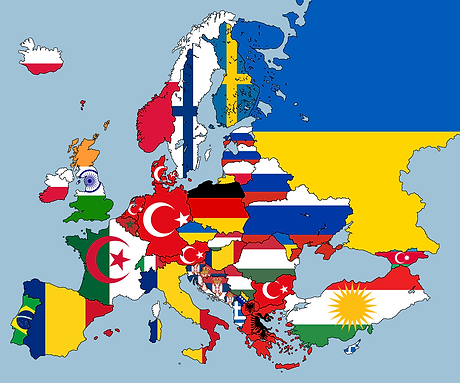
EUROPE IN THE GLOBAL 1970s
Global Change


West Indies to the UK
In the years following World War II, the United Kingdom experienced a labor shortage. Employment sectors necessary for the country's post-war reconstruction weren't being filled by native workers. And so, while the UK welcomed large contingents of migrant laborers from Italy, Portugal and elsewhere, thousands of immigrants from the Caribbean — or "West Indies" — also arrived in the UK. Unlike guest workers though, these populations had come to stay.
Decolonization and a Return to Europe
The decolonization of Africa began in the mid-to-late 1950s. Due to the tensions and conflicts post war era and going into the cold war, the decolonization of many african countries were very unorganized and occurred quickly. This caused widespread unrest and riots in French Algeria, Portuguese Angola, the Belgian Congo and British Kenya. With the decolonization of many European run colonies, this caused mass immigration of post colony residents to Europe.


The 1973-74 Oil Crisis
Beginning in 1973, much of western Europe, as well as the United States, Canada and South Africa experienced one of the worst energy crises of all time, when the Arab members of OPEC declared an oil embargo in response to "the West's" support of Israel (Priest, 117-8). The embargo severely limited the oil supply and prices soared (Priest, 118). As a result, western European nations were forced to rethink their economic approach. The crisis was one of the driving factors behind an economic downturn that cast a negative light on the region's high immigration rates.
Increasingly "Foreign" Populations
The preponderance of post-WWII refugees, guest workers, and immigrants in search of a better life in the years leading up to the 1970s made western European societies more heterogeneous than ever before. With the onset of economic uncertainty and increased exposure to racial variance, immigrant populations served as a timely scapegoat for "native" Europeans.
West Indies to the UK
The Empire Windrush arrived in London on June 22, 1948 from Jamaica (McDowell). A bulk of the 1,000 or so passengers onboard had come to start a new life for themselves and their families in the United Kingdom. These Caribbean immigrants were attracted to job opportunities in the UK and were also looking to "escape societal oppression, to evade familial restrictions or escape poverty" in their home nations (McDowell). The UK in turn, was desperately in need of workers to fill labor vacancies in manufacturing, construction, transportation, food service and healthcare sectors. Not only was the population of the UK growing older, but a large population of Brits had immigrated to Australia, Canada and other English-speaking countries in the post-war period (McDowell). And so, immigrants from Jamaica, Trinidad and Tobago, Barbados and elsewhere had come to fill the void. By 1960, there were 161,000 Caribbean-born men and women living in the UK (McDowell).

Life in the UK as a Caribbean immigrant was far from easy though. Despite being British citizens from the "New" Commonwealth, these workers faced prejudicial ideology and behavior constantly (McDowell). They were often confined to certain neighborhoods of the city — Notting Hill in London being the most well-known — and were forced into the country's lowest paying jobs. As Linda McDowell explains "almost half of all the men who came from the Caribbean to the UK throughout the 1950s had previously worked in skilled positions or possessed excellent employment credentials... [but] found their access restricted to jobs the local population considered undesirable, including street cleaning and general labouring, or to jobs that demanded anti-social hours such as working night shifts." And so, many Caribbean immigrants filled positions they were significantly over-qualified for.
As the testimonies of Caribbean women in the healthcare sector indicate, racism was prevalent (McDowell):
"When I first started coming in the country and was nursing, the older patient was not used to black people so they were very nasty. They will take their things and throw at you or call you black and whatever and things like that."
"We were told to clean lockers and the beds, we were made to go and clean the wheelchairs and the commodes. We did a lot of menial jobs."
The introduction of Caribbean immigrants into the UK during the 1950s and 60s certainly benefited the nation's economy. And eventually, many of the immigrants who were able to overcome the racism and discrimination successfully settled into their new lives in the UK (McDowell). But, the UK's treatment of these immigrant populations was one of the first examples of European xenophobia that would characterize much of the 1970s.

Decolonization and a Return to Europe
In 1945 Africa only had 4 independent countries, these were Egypt, Ethiopia, Liberia and South Africa. After WWII many of the colonies became independent due to the fall of their European rulers. Multiple civil wars broke out throughout Africa due to civil unrest and conflict over independence. This unrest spread into Europe, causing riots throughout the previous colonial powers. It caused much debate whether or not to allow immigrants to move to Europe and gain independence. Algérie française was a slogan used about 1960 by those French people who wanted to keep Algeria ruled by France. By 1977 European colonial rule in mainland Africa had ended. Mass immigratio to Europe from Africa occurred, supplying large numbers to the workforce.

The 1973-74 Oil Crisis
The picture seen above of four horsemen riding through the streets of Amsterdam looks like something out of a post-apocalyptic film. In reality though, this picture was taken in the wake of the oil embargo enforced by the Arab members of OPEC, the Organization of the Petroleum Exporting Countries, on western Europe, the United States, Canada and other countries in 1973. The embargo was announced after western Europe and the United States had supported Israeli forces in the Yom Kippur War against Egypt, Syria and other Arab nations. The crisis "consisted of two distinct but interrelated crises" writes Tyler Priest (118), "one was political, which was the six-month embargo shaped by the Arab-Israeli conflict, and the other was economic, which concerned the renegotiation of oil agreements." Either way, the crisis left western Europe — which had become increasingly dependent on oil — scrambling to not only find alternative fuel sources but also to restructure its economic landscape (Van Mol & de Vak, 35). Given the rise in oil consumption worldwide, OPEC states were taking in much more money than they were able to spend and so, western European leaders had to decide "how to manage the circulation of vast quantities of petrodollars" (Gray, 172). Turning away from the conventional principles of "recycling" and restrictive capital control though, West German finance minister Helmut Schmidt advocated for "opening the floodgates" (Gray, 177). In the months after the embargo, neoliberal approaches to the economy, in which state intervention was relatively minimal, were put in place by many European nations, like West Germany, in order to deal with inflationary conditions exacerbated by the crisis (Gray, 173, 191-2). This about-face accompanied a reduced need for labor in western Europe caused by the 1973 oil crisis (Van Mol & de Vak, 35). As a result, with economic growth now stagnant, immigration was no longer quite so beneficial. As Van Mol and de Vak (35) write, "Switzerland and Sweden were the first countries to invoke a migration stop, respectively, in 1970 and 1972... others followed: Germany in 1973 and the Benelux and France in 1974." The 1973-74 oil crisis and concurrent economic downturn had a profound effect on European sentiments towards immigration, making both governments and populations wary of accepting newcomers for the rest of the 1970s.
A look at the numbers...
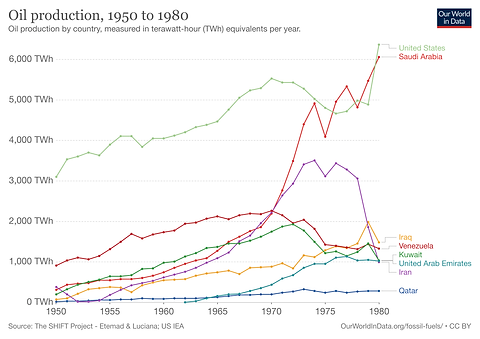
The graph seen on the left depicts the oil production levels of eight countries from 1950 to 1980. Throughout the 1950s and 60s, members of OPEC — such as Saudi Arabia, Iran, Iraq, Venezuela, United Arab Emirates, Kuwait and Qatar — saw a significant increase in production. Western Europe, the United States and Canada had become increasingly reliant on OPEC oil supplies in the post-WWII era. The graph clearly represents why OAPEC's 1973 embargo had such a devastating effect on western Europe. (Our World in Data)
The graph to the right of crude oil prices from 1960 to 1990 drives home the devastating effects of the 1973 embargo on the supply and price of oil. We see a sharp increase from $3.29 to $11.58 per barrel of oil from 1973 to 1974. The price skyrockets again at the end of the 1970s, as oil production decreases in the wake of the Iranian Revolution. (Our World in Data)

Increasingly "Foreign" Populations
By the start of the 1970s, after a 25-year period of consistent immigration, European nations featured a conglomerate of races, languages and religions. The continent at large, had become increasingly "foreign" and to so-called "native" populations, it was evident (Van Mol & de Valk, 35). As unemployment grew amidst an economic downturn — an inevitable development given the exceptional industrial growth experienced directly after the war — immigrants were viewed as an excess burden. Van Mol and de Valk (36) note, "in France, for example, Le Pen’s Front National acquired considerable political support for its simple message that '2 million unemployed = 2 million immigrants too many.'" What was once a welcomed form of post-WWII reconstruction became an easy target for political exploitation in the 1970s. Many western European nations established immigration regulations and xenophobic backlash towards "foreigners" became increasingly common (Van Mol & de Valk, 34-6). In the table seen below, taken from Van Mol and de Valk's chapter, we see a noticeable rise in minority populations in western European countries from 1950 to 1975, increasing the visibility of diverse inhabitants.